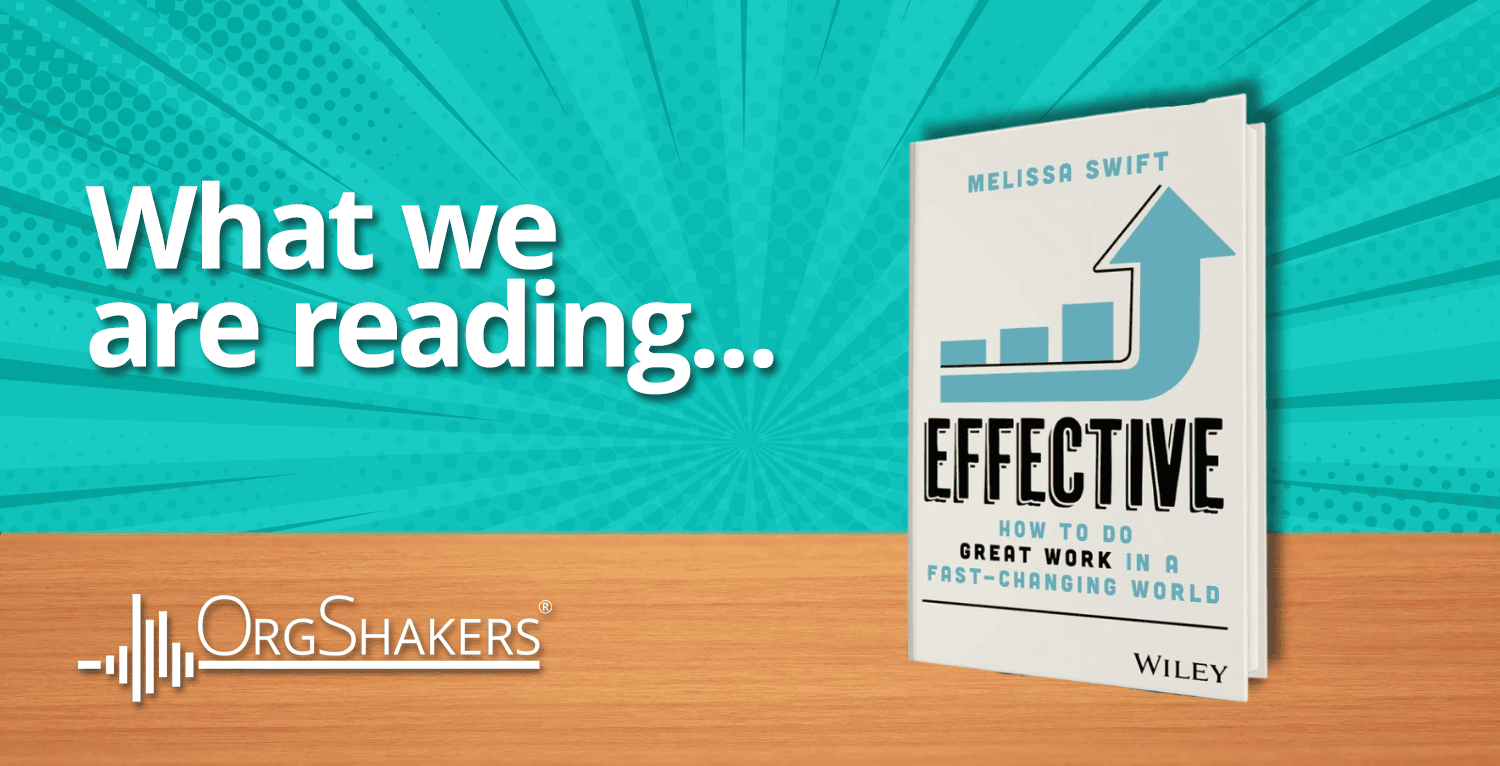
For this month’s reading pick, we turned our attention to a question that feels increasingly relevant in today’s workplace: what does it actually mean to be effective? With work becoming faster, more complex, and often more chaotic, Melissa Swift’s Effective: How to Do Great Work in a Fast-Changing World offers a timely and practical look at how individuals and organizations can do great work without losing themselves in the process.
Melissa Swift, a workplace consultant and the founder and CEO of Anthrome Insight, draws on research, interviews with leaders and academics, and insights from professions where getting things right really matters, including emergency medicine, firefighting, and air traffic control. The result is a book that feels grounded in the realities of work rather than another generic guide to productivity.
At its core, Effective argues that being effective is not simply about working harder, moving faster, or checking more things off a to-do list. Instead, Melissa encourages readers to understand what makes them good at their work and to build on those sources of capability. She also explores the forces that can make effectiveness increasingly difficult, including work intensification, emotional demands, hyper-transparency, and the sheer chaos of modern working life.
One of the book’s most interesting ideas is that many of the problems we experience at work are not necessarily personal shortcomings. Sometimes the way work is designed or technologically enabled is making it harder to perform well. Melissa therefore encourages readers to look beyond individual productivity and consider the systems surrounding them. This feels particularly relevant for HR leaders, who are often tasked with improving performance while also navigating the unintended consequences of new technologies, changing expectations, and increasingly complex workplaces.
The book also has an important perspective on AI. Rather than treating technological change simply as a threat, Melissa encourages readers to identify the human capabilities that make them effective and consider how those strengths can be protected and developed as technology changes the nature of work.
A particular strength of Effective is its accessible and refreshingly practical approach. The author is interested in what people can actually do differently, rather than simply diagnosing what is wrong with modern work. Her use of examples from outside the corporate world also makes the ideas feel fresh and applicable.
Overall, Effective is a valuable read for anyone interested in how we can create workplaces where people are able to do their best work. For HR leaders in particular, it offers a useful reminder that effectiveness is not just about asking employees to perform better. It is also about designing work, technology, and organizational systems that make great performance possible.
If you’re looking for a practical perspective on navigating the increasingly complicated world of work, Effective is well worth adding to your reading list. You can grab a copy of it here in the UK and here in the US.