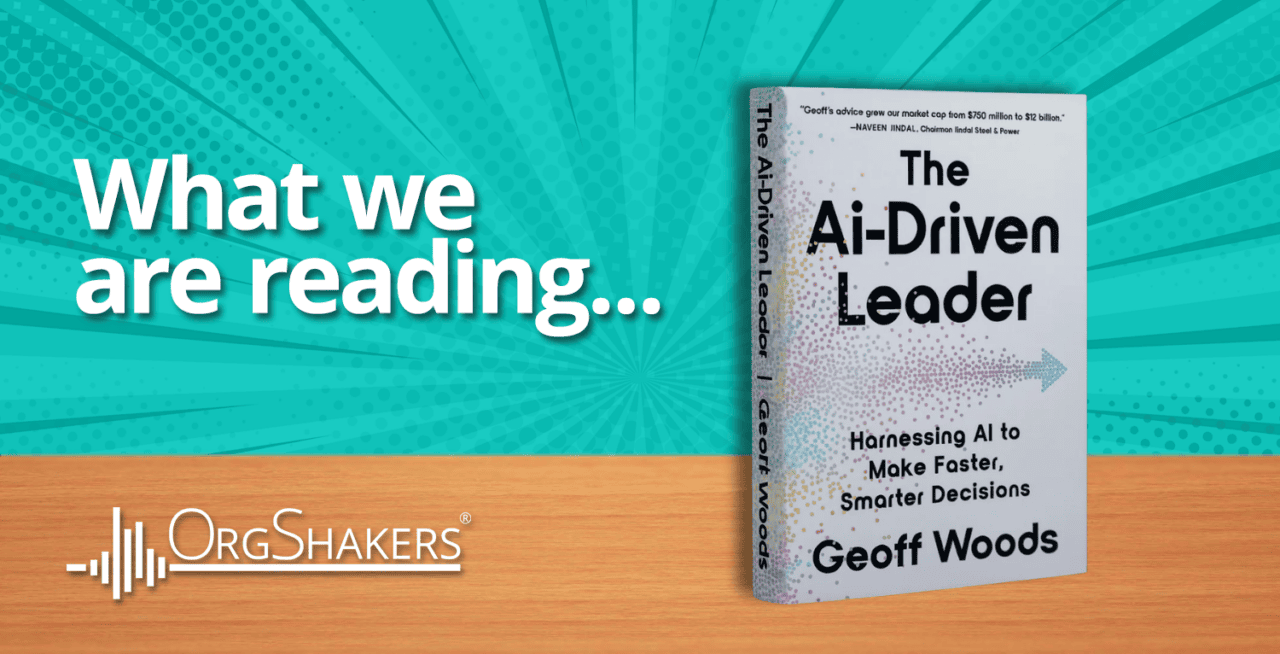
For this month’s reading pick, we explored one of the biggest questions facing organizations today: how leaders can adapt and thrive in the age of artificial intelligence. That led us to The AI-Driven Leader: Harnessing AI to Make Faster, Smarter Decisions by Geoff Woods, a practical and forward-thinking book that examines how AI is reshaping leadership, decision-making, and the future of work.
Geoff Woods, entrepreneur, leadership strategist, and former Chief Growth Officer of Jindal Steel & Power, approaches the topic from a refreshingly practical angle. Rather than focusing solely on the technology itself, he centers the conversation around how leaders can use AI to improve thinking, productivity, and strategic focus. The result is a book that feels highly relevant not just for technology teams, but for HR leaders and business owners navigating rapid organizational change.
At its core, the book argues that AI should not be viewed simply as another workplace tool, but as a transformational shift in how work gets done. Geoff suggests that the leaders who succeed in the coming years will not necessarily be those with the deepest technical expertise, but those who are most willing to rethink traditional ways of operating. Throughout the book, he emphasizes that AI has the potential to enhance human capability rather than replace it, particularly when used intentionally and strategically.
The book begins by addressing the hesitation and uncertainty many leaders currently feel around AI. Geoff acknowledges that the pace of technological change can feel overwhelming, but he challenges readers to move beyond fear-based thinking and instead focus on opportunity. He argues that avoiding AI entirely may ultimately create a greater risk than engaging with it thoughtfully.
From there, the focus shifts to practical application. Geoff explores how leaders can use AI to streamline decision-making, reduce low-value administrative work, and create more time for strategic thinking and innovation. A particularly strong aspect of the book is its emphasis on asking better questions. Rather than treating AI as a shortcut, Geoff frames it as a tool that can amplify critical thinking and problem-solving when paired with strong leadership judgment.
Another key theme running throughout is adaptability. The book repeatedly highlights that the organizations best positioned for the future will be those that build cultures of curiosity, learning, and experimentation. For HR professionals especially, this raises important conversations around workforce confidence and how to help employees embrace change rather than fear it.
What makes The AI-Driven Leader particularly effective is its balanced tone. Geoff is optimistic about AI’s potential, but he does not ignore the challenges that come with it. Issues such as trust, ethics, and maintaining human connection remain central to the discussion, which helps ground the book in the realities organizations are currently facing.
Overall, this book is a highly relevant read for anyone thinking about the future of leadership and work. It offers a useful reminder that while AI may transform processes and productivity, effective leadership will still depend on those distinctly human qualities of judgement and empathy.
If your organization is beginning to explore how AI could support leadership, productivity, or workforce strategy, we would be happy to help you navigate the conversation, so get in touch with us today.
And in the meantime, this is well worth adding to your reading list if you are thinking about how leadership is evolving in the age of AI. You can purchase a copy here in the US and here in the UK.