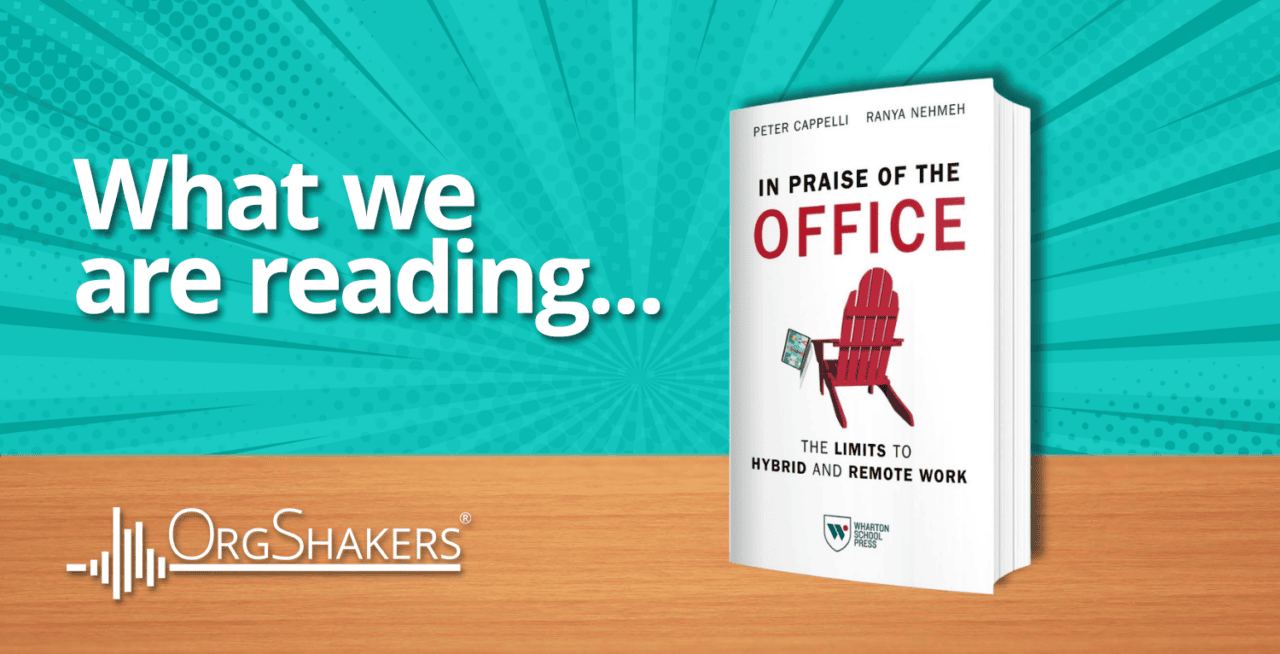
For this month’s reading pick, we turned our attention to one of the most debated topics in today’s workplace: where work should actually happen. That led us to In Praise of the Office by Peter Cappelli and Ranya Nehmeh, a timely and thought-provoking book that challenges some of the prevailing narratives around remote and hybrid working.
Peter Cappelli, a well-known HR scholar and professor at the Wharton School, alongside Ranya Nehmeh, a senior HR strategist and adjunct university professor, brings a research-led yet highly practical perspective to the discussion. Rather than taking an extreme stance, the authors aim to rebalance the conversation by exploring what the office still offers that remote work often struggles to replicate.
At its core, the book argues that while remote work has delivered clear benefits, particularly in terms of flexibility and autonomy, it has also introduced less visible downsides. Peter and Ranya highlight how spontaneous collaboration, informal learning, and relationship-building are significantly harder to recreate in fully remote environments. They suggest that these ‘invisible’ elements of work are often undervalued until they begin to disappear.
The book begins by unpacking how quickly organizations shifted their working models during the pandemic, often without fully understanding the long-term implications. What started as a necessary response has, in many cases, become a default approach. The authors challenge HR leaders to question whether current policies are truly intentional, or simply a continuation of temporary measures.
From there, the focus shifts to the unique role of the office. Rather than positioning it as a place for routine, individual tasks, Peter and Ranya reframe it as a hub for connection, creativity, and culture. They argue that the office is at its most valuable when it is used deliberately for collaboration, mentoring, and complex problem-solving, rather than as a mandatory, one-size-fits-all requirement.
A particularly strong element of the book is its balanced tone. The authors are careful not to dismiss remote work outright, instead advocating for a more thoughtful hybrid approach. They emphasize that the real challenge for HR is not choosing between remote or office work, but designing systems that intentionally support both productivity and human connection.
A key theme running throughout is intentionality. Much like communication or performance management, workplace design should not be left to chance. They encourage organizations to move away from reactive policies and towards evidence-based decisions about when, where, and why people come together.
Overall, In Praise of the Office is a highly relevant read for employers navigating the ongoing evolution of work. It offers a useful reminder that while flexibility is important, so too are the social and developmental aspects of work that are often easiest to foster in shared spaces.
If you would like to discuss how to design a hybrid working model that balances flexibility with connection in your organization, please do get in touch with us today.
And in the meantime, this is well worth adding to your reading list if you are rethinking the role of the office in a post-pandemic world. You can purchase a copy here in the US and here in the UK.